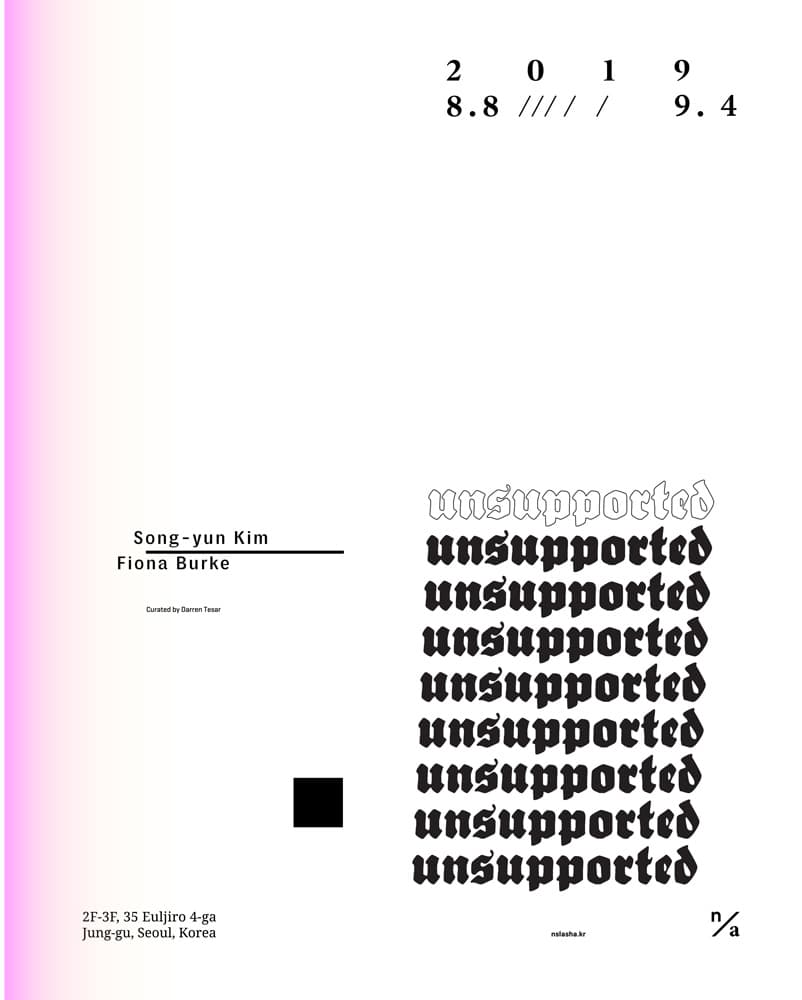
Unsupported
N/A
2019년 8월 8일 ~ 2019년 9월 4일
1 / 2
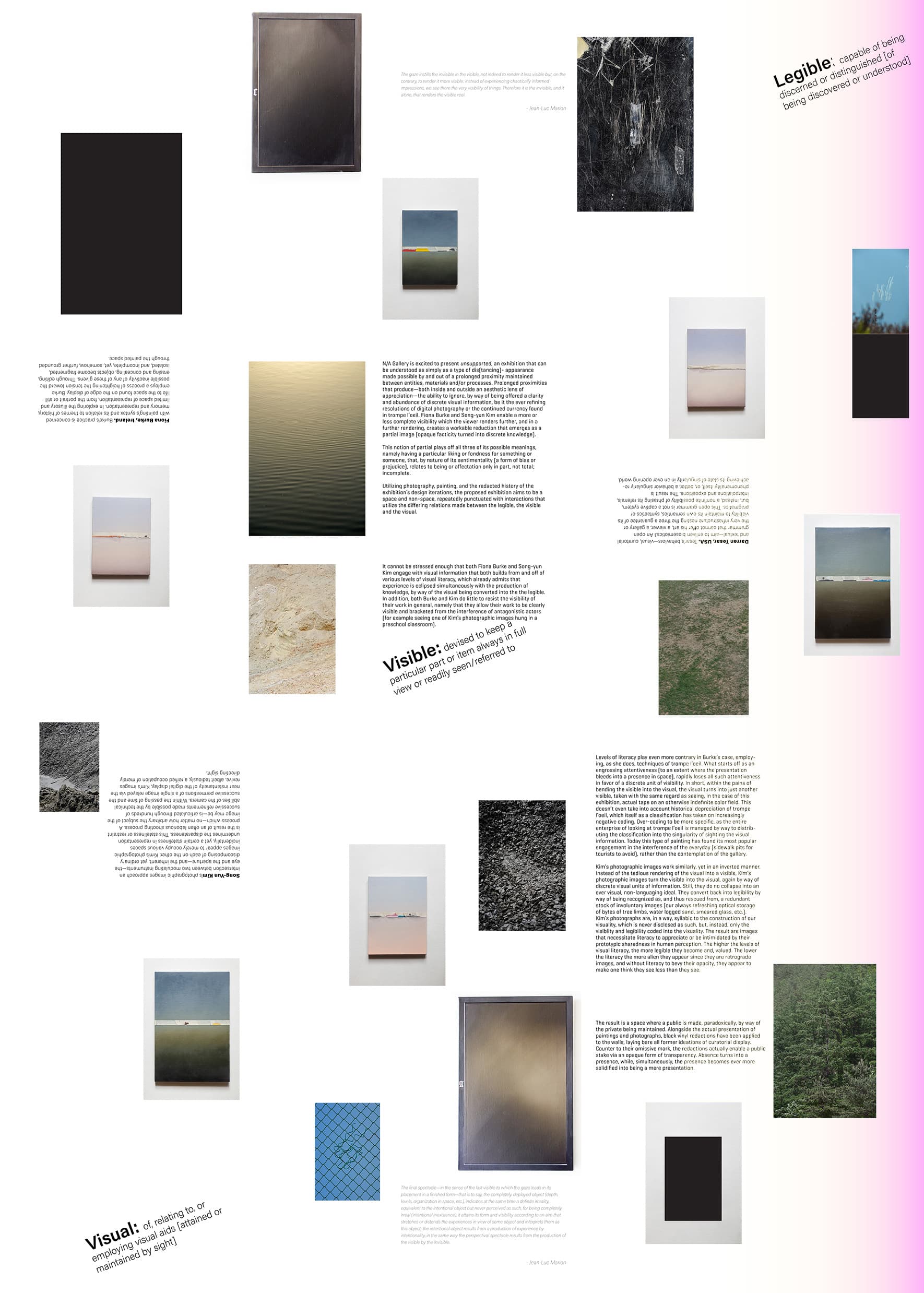
Fiona Burke와 김성윤의 작업은 디지털 사진의 해상력과 트롱프뢰유(trompe l’oeil)/하이퍼리얼리즘를 통해 명료한 시각정보를 제공함으로써 역설적으로 특정한 해석을 유도하지 않는다. 보는 이의 관점과 취향에 따른 편향된 감상에 (설령 그것이 작업의 가치를 곡해하더라도) 초연하며, 궁극적으로 가시적, 시각적, 그리고 지각 가능한 요소의 상호작용에 대한 담론을 이끌어낸다. Fiona Burke는 역사, 기억, 재현에 관련된 회화적 문법에 관심을 가진다. 기계적 재현의 기법으로 인식되어 현대미술에서 자리를 잃어가는 트롱프뢰유 화법으로 재현된 테이프, 티브이와 같은 일상적인 오브제는 객관적-가시적 성질이 강조된다. 반면 무한하고 추상적인 깊이로 묘사되는 색 면은 지극히 시각적인데, 이들이 순차적으로 지각하고 반복되는 과정에서 생성되는 긴장감이 캔버스의 물리적 경계까지 스며든다. 한편 무작위적으로 촬영된 듯 한 김성윤의 이미지공간에는 반복적이고 끈질긴 정제과정으로 완성된 특유의 절제 혹은 무게가 더해짐으로써 중립적-가시적 재현과 의도적-시각적 표현의 영역이 중첩된다. 시각적 문해력(visual literacy)을 요구하는 그의 이미지는 관람자의 분석력에 따라 지각 가능한 음절이 늘어나고 우리의 인지범위의 공통점과 한계를 상기시키는 성찰의 기회를 제공하지만 그렇지 않은 경우 역행적인 모호함으로 다가오기도 한다. 이렇듯 닫혀있으며 동시에 열려있는 이들의 작업을 기획자 Darren Tesar는 자신의 능동적인 공간해석의 흔적(검은 사각형)과 함께 존재와 묘사의 경계가 불분명한 공간, 혹은 비공간으로 연출하려 한다.
The gaze instills the invisible in the visible, not indeed to render it less visible but, on the contrary, to render it more visible: instead of experiencing chaotically informed impressions, we see there the very visibility of things. Therefore it is the invisible, and it alone, that renders the visible real.
- Jean-Luc Marion
N/A Gallery is exited to present 지지가없는, an exhibition that can be understood as simply as a type of dis(tancing)- appearance made possible by and out of a prolonged proximity maintained between entities, materials and/or processes. Prolonged proximities that produce—both inside and outside an aesthetic lens of appreciation—the ability to ignore, by way of being offered a clarity and abundance of discrete visual information, be it the ever refining resolutions of digital photography or the continued currency found in trompe l’oeil. Fiona Burke and Song-yun Kim enable a more or less complete visibility which the viewer renders further, and in a further rendering, creates a workable reduction that emerges as a partial image (opaque facticity turned into discrete knowledge).
This notion of partial plays off all three of its possible meanings, namely having a particular liking or fondness for something or someone, that, by nature of its sentimentality (a form of bias or prejudice), relates to being or affectation only in part, not total; incomplete.
Utilizing photography, painting, and the redacted history of the exhibition’s design iterations, the proposed exhibition aims to be a space and non-space, repeatedly punctuated with interactions that utilize the differing relations made between the legible, the visible and the visual.
Legible: capable of being discerned or distinguished [of being discovered or understood]
Visible: devised to keep a particular part or item always in full view or readily seen/referred to
Visual: of, relating to, or employing visual aids [attained or maintained by sight]
It cannot be stressed enough that both Fiona Burke and Song-yun Kim engage with visual information that both builds from and off of various levels of visual literacy, which already admits that experience is eclipsed simultaneously with the production of knowledge, by way of the visual being converted into the the legible. In addition, both Burke and Kim do little to resist the visibility of their work in general, namely that they allow their work to be clearly visible and bracketed from the interference of antagonistic actors (for example seeing one of Kim’s photographic images hung in a preschool classroom).
Levels of literacy play even more contrary in Burke’s case, employing, as she does, techniques of trompel’oeil. What starts off as an engrossing attentiveness (to an extent where the presentation bleeds into a presence in space), rapidly loses all such attentiveness in favor of a discrete unit of visibility. In short, within the pains of bending the visible into the visual, the visual turns into just another visible, taken with the same regard as seeing, in the case of this exhibition, actual tape on an otherwise indefinite color field. This doesn’t even take into account historical depreciation of trompe l’oeil, which itself as a classification has taken on increasingly negative coding. Over-coding to be more specific, as the entire enterprise of looking at trompe l’oeil is managed by way to distributing the classification into the singularity of sighting the visual information. Today this type of painting has found its most popular engagement in the interference of the everyday (sidewalk pits for tourists to avoid), rather than the contemplation of the gallery.
Kim’s photographic images work similarly, yet in an inverted manner. Instead of the tedious rendering of the visual into a visible, Kim’s photographic images turn the visible into the visual, again by way of discrete visual units of information. Still, they do no collapse into an ever visual, non-languaging ideal. They convert back into legibility by way of being recognized as, and thus rescued from, a redundant stock of involuntary images (our always refreshing optical storage of bytes of tree limbs, water logged sand, smeared glass, etc.). Kim’s photographs are, in a way, syllabic to the construction of our visuality, which is never disclosed as such, but, instead, only the visiblity and legibility coded into the visuality. The result are images that necessitate literacy to appreciate or be intimidated by their prototypic sharedness in human perception. The higher the levels of visual literacy, the more legible they become and, valued. The lower the literacy the more alien they appear since they are retrograde images, and without literacy to bevy their opacity, they appear to make one think they see less than they see.
The result is a space where a public is made, paradoxically, by way of the private being maintained. Alongside the actual presentation of paintings and photographs, black vinyl redactions have been applied to the walls, laying bare all former ideations of curatorial display. Counter to their omissive mark, the redactions actually enable a public stake via an opaque form of transparency. Absence turns into a presence, while, simultaneously, the presence becomes ever more solidified into being a mere presentation.
The final spectacle—in the sense of the last visible to which the gaze leads in its placement in a finished form—that is to say, the completely deployed object (depth, levels, organization in space, etc.), indicates at the same time a definite irreality, equivalent to the intentional object but never perceived as such, for being completely irreal (intentional inexistence), it attains its form and visibility according to an aim that stretches or distends the experiences in view of some object and interprets them as this object; the intentional object results from a production of experience by intentionality, in the same way the perspectival spectacle results from the production of the visible by the invisible.
- Jean-Luc Marion
Song-Yun Kim, South Korea. Song-Yun Kim’s photographic images approach an intersection between two modulating instruments—the eye and the aperture—and the inherent, yet ordinary discomposing of each on the other. Kim’s photographic images appear to merely occupy various spaces incidentally, yet a certain stateliness in representation undermines the disparateness. This stateliness or restraint is the result of an often laborious shooting process. A process which—no matter how arbitrary the subject of the image may be—is articulated through hundreds of successive refinements made possible by the technical abilities of the camera. Within the passing of time and the successive permeations of a single image relayed via the near instantaneity of the digital display, Kim’s images revive, albeit tediously, a reified occupation of merely directing sight.
Fiona Burke, Ireland. Burke’s practice is concerned with painting’s syntax and its relation to themes of history, memory and representation. In exploring the illusory and limited space of representation, from the portrait or still life to the space found on the edge of display, Burke employs a process of heightening the tension toward the possible inactivity of any of these givens. Through editing, erasing and concealing, objects become fragmented, isolated, and incomplete, yet, somehow, further grounded through the painted space.
Darren Tesar, USA. Tesar’s behaviors—visual, curatorial and textual—aim to enliven biosemiotics.1 An open grammar that cannot offer his art, a viewer, a gallery or the very infrastructure nesting the three a guarantee of its viability to maintain its own semantics, syntactics or pragmatics. This open grammar is not a captive system, but, instead, a nonfinite possibility of phrasing its referrals, interpolations and expositions. The result is phenomenality itself, or, better, a behavior singularly reachieving its state of singularity in an ever opening world.
1 Biosemiotics is an interdisciplinary research agenda investigating the myriad forms of communication and signification found in and between living systems.
참여작가: 김성윤, Fiona Burke
기획: Darren Tesar
출처: n/a
* 아트바바에 등록된 모든 이미지와 글의 저작권은 각 작가와 필자에게 있습니다.
운영시간
월요일 휴관
화요일 휴관
수요일 휴관
목요일 12:00 - 19:00
금요일 12:00 - 19:00
토요일 12:00 - 19:00
일요일 14:00 - 19:00
휴관: 월요일, 화요일, 수요일
모든 프로그램은 주최측의 사정으로 변경될 수 있으니 자세한 내용은 홈페이지를 확인하시기 바랍니다.
AD